Dental Bridge & Implant Bridge in Naperville, IL
Decay, injury, or recent tooth removal can leave several neighboring teeth missing. When that happens, an implant-supported bridge is the most effective way to restore your smile, your bite, and your confidence. If you're replacing just one gap, you may prefer a single-tooth implant instead, and if you're facing the loss of an entire arch, full arch implants are worth exploring. Rather than relying on adjacent teeth for support like traditional bridges, implant bridges anchor directly to your jawbone, preserving bone, protecting surrounding teeth, and providing a permanent, natural-looking result. Dr. Brammeier will create a custom treatment plan at Brammeier Dental of Naperville to replace your missing teeth and restore full function.
What it is
Rather than natural teeth, two or more dental implants support a fixed bridge that replaces three or more missing teeth in a row with a permanent, non-removable restoration.
Who it's for
Anyone missing several neighboring teeth who wants a permanent, stable solution that preserves bone while leaving healthy adjacent teeth untouched.
How we help
Optimal implant placement guided by precise digital imaging, custom-designed bridges that match your natural teeth, and a treatment plan tailored to your specific situation.
Missing teeth shouldn't hold you back. An implant bridge restores your smile permanently.
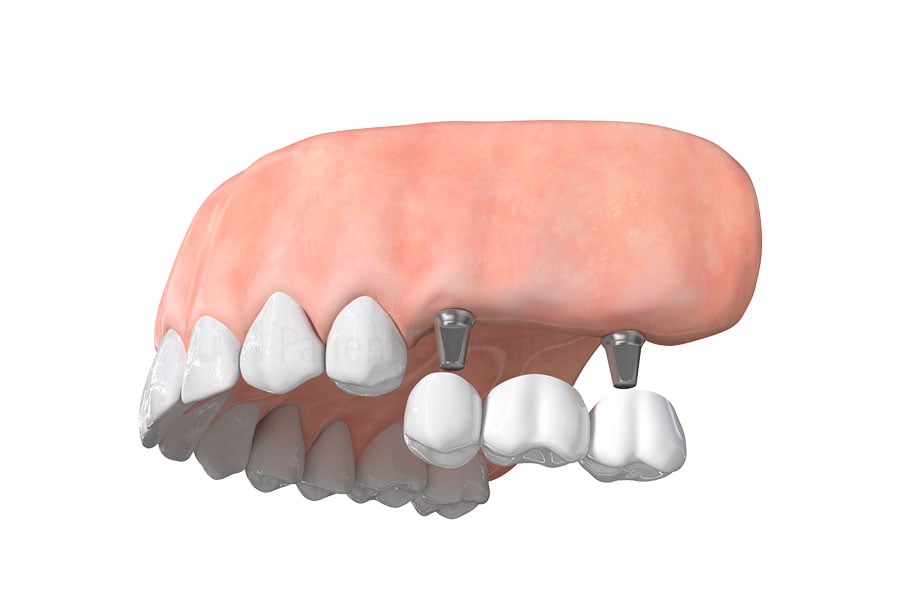
How an Implant Bridge Works
- Two or more titanium implants are set into the jawbone to act as anchors
- A custom bridge of connected porcelain crowns fastens to those implants
- In a single fixed restoration, the bridge replaces three or more missing teeth
- Unlike traditional bridges, no healthy teeth need to be filed down or crowned
- By stimulating the jawbone, the implants prevent the bone loss that comes with missing teeth
- The result looks, feels, and functions like your natural teeth

Why Replace Missing Teeth Now?
- Bone loss accelerates: With no tooth roots in place, the jawbone resorbs and shrinks rapidly
- Teeth shift: Surrounding teeth drift into the open spaces, bringing misalignment and bite problems
- Remaining teeth are at risk: The teeth compensating for the missing ones bear extra stress and may be lost too
- Chewing becomes difficult: Missing teeth limit your ability to eat a full range of foods
- Facial changes: Bone loss can give the jaw a sunken, aged appearance
- The sooner you act, the simpler and more affordable treatment will be
Advantages of an Implant Bridge
- Beautiful, natural appearance: Custom-crafted porcelain crowns matched perfectly to your existing teeth
- Eat any food: Because implant bridges are permanently fixed, you can eat, bite, and chew with full confidence
- No shifting or moving: Anchored straight to the jawbone for rock-solid stability
- Preserves bone: By stimulating the jawbone, implants prevent the deterioration that follows tooth loss
- Protects adjacent teeth: Unlike traditional bridges, no grinding down of healthy neighboring teeth
- Long-lasting: With proper care, implant bridges can last decades
The Treatment Process
- Consultation: Using digital X-rays and CT scans, Dr. Brammeier evaluates your teeth and jawbone
- Treatment plan: A personalized plan is built around the number of missing teeth and available bone
- Implant placement: Under local anesthesia, titanium posts are surgically placed into the jawbone
- Healing period: Over 3–6 months, the implants fuse with the bone (osseointegration)
- Bridge fabrication: Custom porcelain crowns are designed and connected to form your bridge
- Final placement: The bridge is permanently attached to the implants, completing your new teeth
An implant bridge replaces missing teeth while leaving your healthy ones alone. Schedule a consultation today.
What to Expect at Your Visit
Visit Steps
- Evaluation: Dr. Brammeier examines your mouth, reviews imaging, and talks through your goals and options
- Custom plan: You receive a detailed treatment plan covering timeline, cost, and what to expect at each stage
- Surgery: Implants are placed in a comfortable office setting, with sedation options available
- Progress checks: Regular follow-up visits track healing and keep everything on course
- Final restoration: Once you've healed, your custom bridge is permanently attached
Helpful Tips
- When significant bone loss has occurred, bone grafting may be needed before implant placement
- Follow all post-surgical instructions carefully to support healing
- For the first few days after implant surgery, stick to soft foods
- Keep up excellent oral hygiene around the implant bridge by brushing and flossing daily
- Keep all scheduled follow-up appointments
- With proper care, your implant bridge can last for many years
Frequently Asked Questions
Bring back your smile and your confidence. Schedule your implant bridge consultation today.